
Table of Contents
Essentials to know
- eSIMs don’t use more power – An eSIM works just like a physical SIM and doesn’t inherently drain extra battery. Modern phones optimise eSIM power extremely efficiently.
- The myth explained – People often blame eSIMs when the real causes are weak signal, roaming, or running two active lines – all of which increase power use regardless of SIM type.
- Dual-SIM usage matters – Using two active numbers increases background radio activity slightly, but this happens with two physical SIMs too. It’s not an eSIM issue.
- Battery drain factors – Signal quality, network type, background apps, and location tracking affect battery life far more than choosing eSIM vs physical SIM.
- How to optimise – Keep Wi-Fi on, disable unused lines, update carrier settings, reduce background activity, and maintain strong signal for the best battery performance.
For many business owners and professionals, switching to an eSIM is one of the easiest ways to run a dedicated business number on the same phone as your personal one. It keeps calls and messages organised, lets you use WhatsApp Business separately, and eliminates the need to carry two devices.
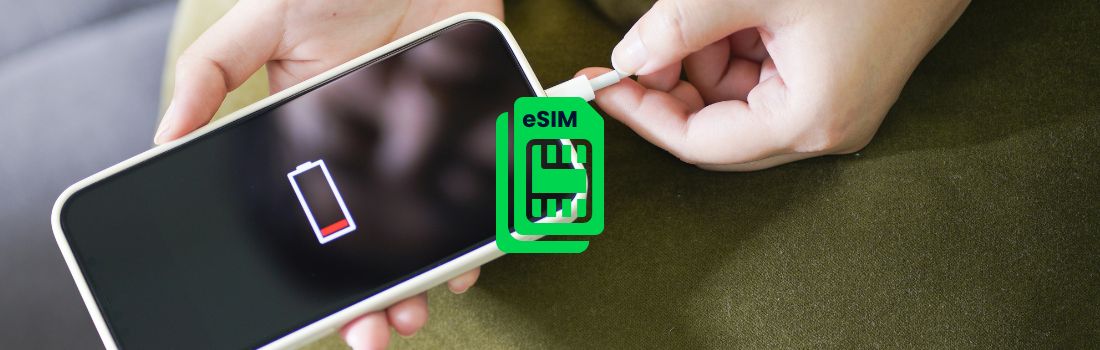
However, we hear one common concern comes up time and time again among our customers – does using an eSIM drain your phone’s battery more quickly than a physical SIM card? So, let’s break down how eSIMs work, where the myth comes from, and what’s actually happening inside your device.
What is an eSIM and how does it work?
An eSIM (embedded SIM) is a digital SIM card built into your device. Instead of inserting a physical SIM card, you activate a digital profile provided by your network or provider.
Functionally, eSIMs work just like physical SIMs:
- They connect your device to your mobile network
- They identify your number and contract
- They allow your phone to make and receive calls and messages, and use mobile data
The only real difference is that eSIMs are software-based, rather than stored on a removable card. This setup offers many benefits, allowing you to switch providers instantly, run dual numbers, and set up a dedicated business line in minutes.
The common myth: eSIMs vs physical SIMs and battery life
A lot of people assume eSIMs use more power because they’re ‘digital’. However, the truth is more nuanced than that. The type of SIM itself is not responsible for battery consumption; instead, battery life primarily depends on a few factors:
- How many active SIM profiles you are using at one time
- Mobile signal strength in the area where you’re using the phone
- Which network you’re connected to (4G, 5G, Wi-Fi, VoLTE)
- Any background app activity and notifications
- Location tracking, system features, and some settings
The SIM type itself does not meaningfully affect battery life, but all the items above can.
So where did the myth come from? Well, in practice, most people switch to an eSIM at the same time as adding a second phone line, roaming abroad, or working in low-signal environments. All of these factors can increase battery use, but it’s not because the SIM they’re using is digital.
Does an eSIM actually drain more battery? The technical truth
The short answer is no, an eSIM does not inherently use more battery than a physical SIM. In fact, modern eSIM modules are integrated directly into the device hardware and are designed to be low-power from the start. This means that:
- Maintaining the network connection uses the same internal hardware whether you use an eSIM or a physical SIM, so there’s no added processing or battery drain.
- There’s no physical SIM slot or reader to power, which ever so slightly reduces the amount of hardware your phone needs to keep running.
- Network authentication happens directly inside the phone’s communication chip, which is designed to handle this process efficiently without using extra power.
In newer phones (particularly iPhone, Samsung Galaxy and Google Pixel), eSIM power efficiency is highly optimised and refined. That means that most users will see no measurable difference in everyday use when compared to a physical SIM.
Factors that can affect battery use when using an eSIM
Battery performance depends on the connection environment, whether you use a physical SIM or an eSIM.
| Factor | Why it affects battery |
| Weak or unstable signal | Your device increases power consumption to hold the connection |
| Roaming abroad | Your phone repeatedly checks for the best available network, which requires extra battery power |
| Running two active numbers | Two network connections means more background radio activity and power |
| Carrier network efficiency | Some providers manage power usage better than others |
It’s worth noting that storing multiple inactive eSIM profiles does not use battery. Only active profiles consume power, and this is the same whether you’re using a dual SIM or an eSIM. If a profile is switched off, it is completely dormant.
How dual SIM (eSIM + physical SIM) impacts power consumption
If you run two lines at once (for example, one personal and one business), your phone maintains two separate network connections in the background, which uses more power than running just one line. However, this would be the case regardless of SIM format. A setup that uses two physical SIM cards will use the same amount of power as a physical SIM and eSIM setup.
The good news is that for most people, the difference in battery life when running two lines is small and easily managed, particularly if your phone usually has good signal.
Tips to optimise battery life when using an eSIM
Small adjustments to how your phone connects can have a noticeable impact on battery performance. First, focus on signal, not the SIM:
- Keep Wi-Fi enabled when available (Wi-Fi uses less energy than mobile data)
- Turn off the second line when you don’t need it
- Use Low Power Mode (switched on in your settings) in low-signal or travel environments
- Regularly install carrier settings updates when prompted
Then, try these tips for general battery care:
- Reduce your screen brightness slightly
- Close any unused apps that you have running in the background
- Limit any unnecessary location tracking and push notifications in settings
These apply to any phone setup – eSIM or physical SIM – and the biggest improvements usually come from strengthening your signal and reducing unnecessary background activity. By keeping your device connected efficiently and streamlining what runs behind the scenes, you’ll maintain reliable battery performance no matter which SIM format you use.
Why eSIMs can be more efficient for business users
For many small business owners, freelancers and self‑employed professionals, communication happens everywhere – on the move, between jobs, or while juggling multiple responsibilities. Using an eSIM makes it easier to keep your work and personal communication organised, without needing extra devices or confusing message threads.
With an eSIM, you don’t need:
- A second phone or handset to carry around
- A separate contract tied to a physical SIM
- To switch between personal and business messages in one WhatsApp app
Instead, you can:
- Activate a dedicated business number instantly, from a trusted provider (like us)
- Use it in WhatsApp Business to keep work conversations separate
- Maintain clearer boundaries between your personal and professional time
This separation helps you stay organised, respond more efficiently, and present a consistent, professional image. It also reduces the risk of missed enquiries and opportunities, because business messages are kept in one place rather than mixed in with personal chats.
Overall, using an eSIM makes it easier to manage your professional communications smoothly and confidently, without changing how your phone functions or affecting battery performance.
Should you worry about battery drain when switching to eSIM?
Essentially, no. The reassuring news is that if you’re using a modern smartphone with a stable mobile signal, you should not notice any difference in battery life when switching to an eSIM. The day‑to‑day battery usage remains the same, because the parts of the phone responsible for power consumption (the modem, antennas, and background network activity) work exactly the same way regardless of whether your SIM is physical or digital.
In the rare situations where people do notice increased battery drain after switching to an eSIM, it usually comes down to environmental factors – such as being in a low‑signal area or running two lines at once – rather than the eSIM itself.
So, rather than thinking of eSIM as something that changes how your battery works, it’s better to think of it as a more flexible, modern alternative to the physical SIM – one that simply fits into your existing phone setup without introducing new battery demands.
eSIM convenience without the power trade-off
eSIMs do not drain more battery than physical SIMs. They are simply a more flexible and modern way to manage mobile connectivity.
If you want to run a separate business number without buying a second phone, an eSIM offers the simplest and most flexible setup. It lets you keep work and personal messages separate, stay organised, and present a professional image, all without carrying a second device.
Harness the power of WhatsApp Business with YourBusinessNumber
Whether you’re adopting an eSIM to simplify your setup, keep work and personal communication separate, or avoid carrying a second handset, the principle is the same: a dedicated business number helps you stay organised and present a clear, consistent identity to your customers. It means enquiries are easier to manage, responses are quicker, and your business appears confident and reliable from the very first message.
YourBusinessNumber makes this straightforward. You can activate your second virtual phone number or business eSIM in minutes and run WhatsApp Business alongside your personal WhatsApp on the same phone. There’s no extra device to carry, no complicated contracts and no disruption to your existing setup – just a smooth, professional way to handle conversations wherever you are.
Ready to keep your communication clean, clear and professional? Get started with us today.
Author:

George Lineker
Get A Virtual Number Now!
Receive your number for WhatsApp verification in just 3 clicks!