



Table of Contents

Essentials to know
- WhatsApp Business comes in two very different forms – the app and the API, each designed for different stages of business growth, with no simple “upgrade” between them.
- The WhatsApp Business app is ideal for small teams and human-led conversations, offering tools like Business Profiles, Quick Replies, Labels and basic automation without technical setup.
- The WhatsApp Business API is built for scale and systems, enabling automation, CRM integrations, chatbots and structured team workflows, but with higher complexity, cost and responsibility.
- For many small and growing businesses, neither option is perfect on its own, as the app can feel limiting for teams while the API can feel excessive for everyday customer communication.
- YourBusinessNumber Teams provides a practical middle ground, letting businesses keep the simplicity of the WhatsApp Business app while easily managing multiple numbers and managing team changes, without moving to the API.
WhatsApp is one of the most widely used communication tools in the world, and for many small businesses, it has become the default way to speak to customers. From enquiries and bookings to order updates and support, WhatsApp Business offers a familiar, real-time method to stay in touch.
But as your business grows, it’s easy to become confused about what WhatsApp Business can and can’t do, especially when you start hearing terms like automation, API, CRM integration, broadcasts, or 24-hour rules.
This guide breaks down the difference between the WhatsApp Business app and the WhatsApp Business API, explains which features are actually available in each, and helps you decide which setup makes sense for your business.
What is WhatsApp Business, and who is it designed for?
WhatsApp Business is a version of WhatsApp created specifically for businesses. It’s designed primarily for sole traders and small teams who want a more professional presence than a personal WhatsApp account, without needing complex systems or technical setup.
At its core, WhatsApp Business is built for businesses that use:
- One main phone number
- One primary device, with up to four additional linked devices
- Direct, human-led conversations with customers
For many businesses, this works very well, but for some, confusion starts when expectations drift beyond what the app was designed to support.
The three types of WhatsApp accounts explained
Before comparing features, it helps to understand the three different WhatsApp account types, as they’re often mixed up:
Personal WhatsApp account
This is supported by the WhatsApp Messenger app and is designed for personal use only. This is primarily used by individuals talking to family and friends, and is not intended for business communication.
WhatsApp Business app
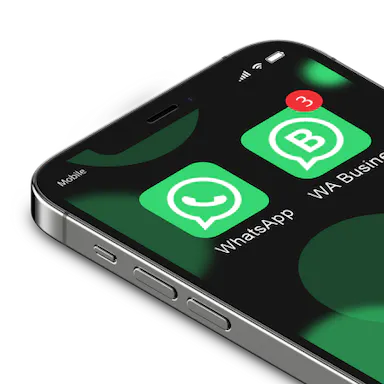
This is a free app for small businesses, offering basic tools such as a Business Profile, Business Catalogue, Quick Replies and simple Auto-Messages. Messages are sent and received manually by a business owner, freelancer, or employees.
WhatsApp Business API
This is a backend service designed for larger or more complex businesses whose needs extend beyond what the WhatsApp Business app can support. It allows WhatsApp to connect to other systems (such as CRMs or help desks) and supports automation, routing and multi-agent workflows.
Each option serves a different purpose – there’s no single ‘best’ choice for every business.
An overview of WhatsApp Business app features (what you actually get)
The WhatsApp Business app includes a lightweight set of tools designed to make conversations easier to manage, without turning WhatsApp into an automated platform.
Key features of WhatsApp Business include:
- A Business Profile with opening hours, address and description
- Labels to organise chats
- Quick Replies (pre-written text snippets which save time and effort)
- Automatic Greeting Messages for new chats
- Automatic Away messages outside business hours
- Product or Service Catalogues
- Use of one account across four linked devices and one primary device
- WhatsApp voice calls (incoming and outgoing)
These features are extremely effective for small-to-medium-sized businesses, but they are intentionally simple and easy to use. They support responsiveness and organisation within a business, not full automation.
WhatsApp Business app vs WhatsApp Business API: what’s the real difference?
One way to understand the difference is this:
- The app is for people
- The API is for systems
The app exists on a phone, and messages are written, read and managed by humans, in real time.
The API allows WhatsApp to connect to other software. Messages can be triggered, routed or analysed by systems – often alongside human agents – depending on how it’s set up.
This one difference explains most of the questions people run into. Once you’re clear on whether WhatsApp is being used by a person on a phone or by systems working in the background, it’s much easier to see why certain features exist, why others don’t, and where the costs come from.
What is a WhatsApp Business Account (WABA)?
You may see the term WhatsApp Business Account (often shortened to WABA) in guides or platform documentation.
In simple terms, a WABA is the underlying business account registered with Meta. That account can then be connected to:
- The WhatsApp Business app, or
- The WhatsApp Business API
For app-based users, this happens mostly in the background. For API users, it becomes more visible because it’s linked to business verification, message templates and system access.
You don’t need to manage a WABA manually when using the app, but understanding the term can help when comparing tools or speaking to providers.
Using WhatsApp Business across multiple devices: how it works
The WhatsApp Business app does support multi-device use, but it’s important to understand what that really means in practice.
You can:
- Use one primary phone
- Link up to four additional devices (such as desktops or tablets)
This setup works well if you want a bit more flexibility – for example, replying from a laptop during the day or having a second device as a backup. All linked devices mirror the same inbox and conversations in real time.
However, this is still designed around convenience rather than teamwork. With the free version of the WhatsApp Business app, there’s currently no way to assign chats, control who replies, or manage conversations in a structured way. Everyone sees the same messages and replies as the same account, which can become limiting as more people get involved.
What features work when your team uses multiple devices
When several people share access via linked devices, your team can:
- Read and reply to messages from different locations
- View synced chat history
- Use Labels, Quick Replies, and Auto-Replies
- Update some parts of the Business Profile (excluding the display name, which may require Meta approval)
- Access and update Business Catalogues (as long as you’ve not connected your Catalogue directly to a Meta Catalogue via Commerce Manager)
- Share responsibility informally
There are also a few things that only work on the main phone, not on linked devices. For example:
- Sharing or viewing live location isn’t supported on linked devices
- Creating or managing broadcast lists needs to be done on the primary phone
- Adding, editing or deleting Status updates isn’t available on linked devices
- Editing the business name, map location, phone number, and linked accounts must be done on a mobile device, not a linked laptop
This setup can work well in small teams, especially when everyone is trusted to dip in and help out as needed. It’s often fine for keeping things moving during busy periods or covering messages when someone is away.
However, there’s no built-in way to assign chats, control permissions or see who’s responsible for each conversation. Everyone sees – and replies from – the same inbox, which can make it harder to stay organised as the team or message volume grows.
Why WhatsApp Business becomes harder to manage as volume grows
As message volume increases, many businesses run into practical issues:
- Conversations aren’t logged in a CRM
- Customer history is spread across phones or devices
- There’s no clear record of which team member replied to whom
- Responsibility for particular conversations may be confusing
- Reporting and analysis are limited
This often leads businesses to switch between WhatsApp and other systems to manually track leads or support cases. That may work well for your business, but if you are running into difficulties on a regular basis, you may need to consider changing to the WhatsApp Business API.
Why WhatsApp Business doesn’t support full automation in the app
One of the most common misconceptions is that WhatsApp Business should support bots and complex workflows directly from within the app itself.
In reality, the app is deliberately designed to be simple. WhatsApp is first and foremost a personal messaging platform, and Meta puts strict limits in place to protect users from spam or overly automated business messages.
Because of that, automation in the app is kept very light-touch:
- Messages are still sent manually by a person
- Automation is limited to basic rule-based replies, such as Greetings or Away Messages
- Bots, decision trees and logic-based flows aren’t supported
If you need messages to be triggered automatically, routed between team members, or handled by a chatbot, that level of automation sits firmly with the WhatsApp Business API.
Auto-replies explained: Greeting Messages vs real automation
The WhatsApp Business app includes two simple auto-message features that are designed to help you manage expectations, rather than replace real conversations:
- Greeting Messages – sent when someone messages you for the first time, or after a long period of inactivity
- Away Messages – sent automatically outside your defined business hours
These messages follow fixed rules and always send the same response. They don’t read the message, respond to questions, or change based on what a customer says, so there’s no real back-and-forth involved.
That said, they’re still genuinely useful for WhatsApp Business users. Greeting Messages can reassure customers that they’ve reached the right place, while Away Messages can explain when you’ll be back and reduce frustration if someone gets in touch outside working hours.
They’re best thought of as a helpful courtesy rather than true automation. For anything more flexible, interactive or responsive, you’ll need to look beyond the app.
Why you can’t send Video Auto-Replies in WhatsApp Business
Auto-replies in the app are text-only by design, and that’s very much a deliberate choice rather than a missing feature.
Allowing businesses to automatically send images or videos – especially without human review – would make it much easier for spammy or misleading content to spread. To avoid that, WhatsApp keeps automated replies simple and predictable, sticking to plain text only.
If you want to automatically send richer content, such as images, PDFs or videos, that’s where the WhatsApp Business API comes in. The API allows this kind of messaging through approved templates and stricter controls, helping WhatsApp balance useful business messaging with a good experience for users.
Common automation requests (and where the confusion comes from)
Businesses often ask for features such as:
- Automatic video replies
- Keyword-based responses
- Chatbots inside the app
- Message routing to different team members
These requests make sense – as message volumes grow, it’s natural to look for ways to save time, respond faster, or make sure enquiries reach the right person.
The confusion often stems from how these features are marketed. Some third-party tools talk about ‘WhatsApp automation’ without clearly explaining that these capabilities don’t live inside the WhatsApp Business app itself. In practice, features like this rely on the WhatsApp Business API and additional systems running in the background, rather than the WhatsApp Business app itself.
Broadcast messages: what’s possible in the app vs the API
Broadcasting works very differently depending on your setup.
With the WhatsApp Business app:
- Broadcasts are limited to 256 recipients at a time
- Recipients must have your number saved in their contacts
With the WhatsApp Business API:
- Broadcasts can be sent at much larger scale
- Messages must use approved templates
- Customers must have opted in to receive messages
This makes the app suitable for small updates, while the API is designed for structured notifications or large-scale messaging.
Voice calls: app vs API
Another important difference is voice calling:
- The WhatsApp Business app supports incoming and outgoing WhatsApp calls through your primary or linked devices
- The WhatsApp API supports voice calls via the Calling API, which requires technical setup through your service provider, rather than working directly through a handset
For businesses that want a simple, ‘one-tap’ way to call customers, the app remains the most practical choice; the API is better suited for businesses building a professional call-centre style setup.
What WhatsApp Business cannot do without the API
Without the API, WhatsApp Business is deliberately limited to keep things straightforward and human‑led. That means it can’t:
- Run chatbots or conversational flows that reply automatically
- Trigger messages based on logic, keywords or external events
- Integrate directly with CRMs or helpdesks
- Assign conversations to specific team members with roles or permissions
- Send automated notifications at scale
These limits exist to protect the quality of conversations on WhatsApp and to make sure the app remains simple, predictable and trusted by users. Once a business needs more structure or automation than this, that’s usually the point where the API starts to make sense.
The 24-hour messaging rule (API only)
One key difference that often catches businesses out is the 24-hour customer service window, which only applies when you’re using the WhatsApp Business API.
- In the app, you can reply to customers freely at any time, whether that’s minutes, hours or even days after they last messaged you
- With the API, businesses can only reply freely within 24 hours of the customer’s most recent message (with one exception – if a customer messages you via a ‘Click-to-WhatsApp’ ad or a Facebook Page button, this window is extended to 72 hours as a reward for using Meta’s discovery tools)
Once that 24- or 72-hour window has passed, any follow-up messages need to use approved message templates. This can feel restrictive at first, but the rule exists to protect users from unexpected or spammy messages and to make sure WhatsApp remains a channel people trust.
In practice, it simply means API-based businesses need to be a bit more deliberate about how and when they follow up with customers, especially outside of active conversations.
When WhatsApp Business API makes sense for growing teams
The API is designed for businesses whose needs have outgrown what the app can comfortably handle. It’s usually a good fit for teams that:
- Deal with a high volume of customer messages every day
- Need clearer structure around who replies to what, and when
- Have teams that need access from more than four linked devices (plus one primary device)
- Rely on automation or CRM integration to keep things organised
- Need more in-depth analytics and reporting on conversations and performance
- Use WhatsApp as a formal support, sales or customer service channel
Used in the right way, the API adds a lot of power and flexibility. That said, it also brings extra complexity, cost and ongoing responsibility, which is why it tends to make the most sense once a business is ready for that next level of setup.
What tools and features become available with the WhatsApp API
With the API, businesses gain access to a much broader set of tools that are designed to support scale, structure and automation. Rather than everything happening on a single phone, these features sit behind the scenes and help teams manage conversations more efficiently.
With the API, businesses can access:
- Chatbots and automated workflows to handle common queries or guide customers through simple processes
- CRM and helpdesk integrations, so conversations are logged alongside customer records
- Message templates and notifications for structured updates, such as confirmations or reminders
- Agent assignment and routing, making it clear who is responsible for each conversation
- Analytics and reporting to understand volumes, response times and overall performance
These features don’t live inside WhatsApp itself. Instead, they’re delivered through approved platforms that connect to WhatsApp via the API, adding structure and insight that isn’t possible with the app alone.
Groups, verification and other practical differences
A few additional differences are worth noting, as they can affect how WhatsApp fits into your day-to-day setup:
- Groups: Numbers used with the WhatsApp Business app can join WhatsApp Groups, which can be useful for community chats or internal coordination. API accounts can create and manage groups, but they are ‘invite-only’ (up to 8 participants).
- Verification: Using the API requires a verified Meta Business Manager account. This is part of Meta’s checks around business legitimacy and messaging use, and it adds an extra step compared to using the app.
- Blue tick: Some API-based businesses may qualify for an official verified badge (often called the blue tick). This isn’t guaranteed and isn’t something most small businesses need, but it can help signal legitimacy on a larger scale.
On their own, these points probably won’t drive your decision. But taken together, they can influence how easy or practical each option feels, depending on how you plan to use WhatsApp in your business.
Do you need to ‘upgrade’ WhatsApp Business to unlock more features?
There is no direct ‘upgrade’ path managed by WhatsApp from the app to the API, and that often surprises people.
They’re separate products built for different situations, rather than different versions of the same tool. Moving to the API isn’t about unlocking a few extra features; it’s a bigger structural change in how WhatsApp is set up and managed.
Note: Historically, moving to the API meant deleting your app account and losing your chat history. However, some solution providers now support ‘Business App Onboarding’. This allows you to migrate to the API while keeping your existing history. However, this process is handled through your chosen service provider and is not a default feature managed directly within the WhatsApp Business app itself.
For many small businesses, the WhatsApp Business app continues to do the job brilliantly, even as they grow. The API becomes necessary only when your needs genuinely exceed what a phone-based setup can support.
Where your phone number fits in: app-based use vs API use
Phone numbers work differently depending on how WhatsApp is set up, and this is one area that’s worth understanding early on.
- With the app, your business number lives on a physical phone, using a SIM, eSIM, or second virtual phone number. That’s why the app is closely tied to a specific device, even when you link additional screens.
- With the API, the number is hosted virtually and managed by systems, which allows multiple people and tools to use it at the same time.
Because of this difference, a number can only be active in one setup at once. Once it’s registered on the API, it can’t be used in the app at the same time. Thinking about how you want to use your number upfront can help avoid unnecessary disruption if you decide to change your setup later.
How to decide between the WhatsApp Business app and API tools
The app is usually the right choice if you want something simple, familiar and easy to manage day to day. It tends to work best for businesses that:
- Value personal, human conversations with customers
- Have a small team (or just one person) handling messages
- Don’t need automation beyond Greeting and Away Messages
- Don’t need integrations or complex workflows
- Want a low-overhead setup that runs directly from a phone and up to four linked devices
The API makes sense when WhatsApp becomes a more central part of how your business operates. It’s often a better fit if you:
- Need more scale, structure or automation to keep up with demand
- Rely on CRM-based workflows or other systems behind the scenes
- Have dedicated tools, platforms or support in place to manage messaging properly
A happy halfway: our Teams solution
For many small and growing businesses, the choice between the WhatsApp Business app and the WhatsApp Business API can feel a bit extreme – one can feel too basic, while the other can feel too complex and expensive. That’s where YourBusinessNumber Teams sits as a practical middle ground.
Our Teams solution is designed for businesses that want to keep using the familiar WhatsApp Business app, but need better control, flexibility and continuity as their team grows. With Teams, you can assign dedicated business numbers to all your team members easily and manage them all from one simple to use dashboard, all without moving to the API or introducing heavy automation. It’s ideal for businesses that want human-led conversations, clean handovers, clear separation between personal and work messaging, and long-term ownership of their WhatsApp Business number, while avoiding the cost and complexity of enterprise API setups.
Setting your WhatsApp Business up properly with YourBusinessNumber
Whichever route you choose, your phone number setup matters. Using a dedicated business number – rather than a personal one – makes it easier to manage access, stay professional and switch tools as your business evolves. With YourBusinessNumber, you can run WhatsApp Business on a separate business number using an business eSIM or second virtual phone number, keeping work and personal communications clearly separated and under control, with easy team-led options to bring multiple staff members on board.
Start simple, stay flexible, and choose the tools that genuinely fit how your business works today.
Author:

George Lineker
Get A Virtual Number Now!
Receive your number for WhatsApp verification in just 3 clicks!